
House Leveling in Beaumont, TX
Full-perimeter house leveling on pier-and-beam and slab-on-grade homes across Beaumont, Jefferson County, Hardin County, and Orange County. Elevation shots, sub-floor adjustment, and re-shim per surveyed rise.
Beaumont House Leveling levels pier-and-beam and slab houses in Beaumont and Jefferson County that sit on Southeast Texas gumbo clay. Old Town, West End, and Calder pads lift in the wet months and drop when that high-shrink-swell clay dries, so floors, doors, and brick go out of plane. What you get is house leveling and foundation repair scoped from an elevation shot at the house, then a written quote after we see the house — not a number invented on the phone. Call (409) 247-2971. A Hardin or Orange County lot on the same gumbo cycle is the same soil problem with a different permit desk; we still have to stand in the crawl or walk the slab before anyone prices piers.
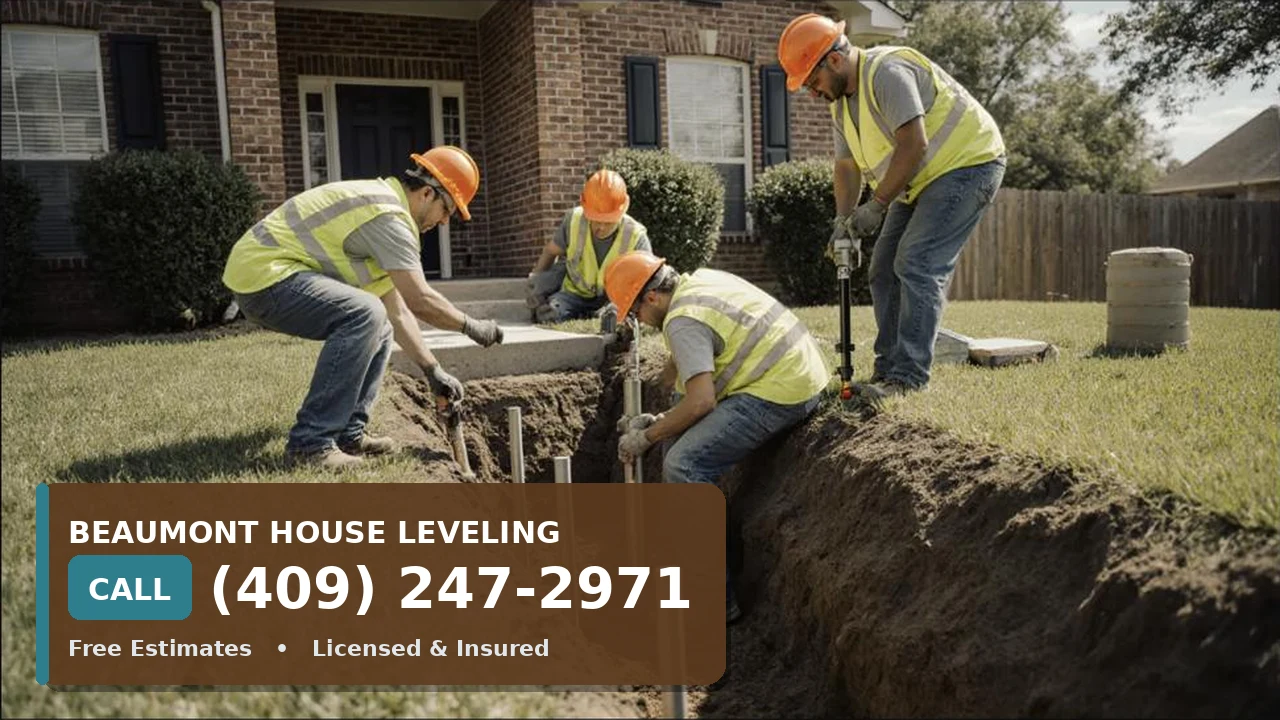
Old Town and West End pier-and-beam houses in Beaumont sit on Southeast Texas gumbo clay that shrinks and swells through a Jefferson County wet season until floors go out of level — call (409) 247-2971 before anyone grouts a moving beam. The failure sequence on this gumbo is local and repeatable: tropical-rain swell lifts the pier pads unevenly around an Old Town perimeter, a dry stretch drops the pads on the sun side faster than the live-oak side, and the pine sub-floor telegraphs that differential as a kitchen that reads level and a hallway that slopes toward a hearth. Beam sag between over-stressed piers is where those Beaumont kitchen floors dip. Grouting the beam without resetting the pads on that clay just hides the next wet-dry swing.
On a pre-1970 Old Town raised-floor house in Beaumont, the honest first step is an elevation shot across the whole floor with a laser or manometer, differential mapped in inches, and a pier-by-pier scope built against that survey — not a one-room shim. That scope often includes rotted pad replacement where roof runoff sat against the beam, sistered joists at the sag lines, and new concrete piers set to the shot elevation. West End and Calder addresses add a second problem: a slab addition bolted to the original pier-and-beam, so the joint between old and new is where brick and trim open first. A written quote comes after we see that mix in person.
Full-perimeter house leveling on pier-and-beam and slab-on-grade homes across Beaumont, Jefferson County, Hardin County, and Orange County. Elevation shots, sub-floor adjustment, and re-shim per surveyed rise.
Full-scope foundation repair for SE Texas homes on Southeast-TX Beaumont clay: pier-and-beam sag correction, slab-on-grade piering, drainage remediation, and re-leveling with post-repair elevation report.
Pier and beam foundation repair: rotted or crushed pad rebuild, sistered joists, sagging beam correction, new concrete piers with jack-set. Standard for Beaumont's older pre-1970 raised-floor housing stock.
Slab-on-grade foundation repair for post-1970 SE Texas homes: pressed concrete piling or steel-pier underpinning, crack epoxy injection, and slab jacking where movement is documented.
Concrete pressed piling underpinning: 12–20 pilings typical per side of a residential slab, driven to refusal on Beaumont's expansive clay. Backfill, grade correction, and finished-elevation report included.
Helical and push-pier steel underpinning where deeper load transfer is required. Engineered depth, load-tested per pier, permanent stainless brackets, and documented lift measurements.
Crawlspace and interior floor leveling: sagging kitchen floors, out-of-level door frames, uneven hearths. Includes sub-floor jacking, sistered joists, and structural post replacement.
Grading, French drain, and downspout extension work to move rainwater away from the foundation. Standard first step where slab movement traces back to perimeter saturation on Beaumont clay.
Pre-sale, pre-purchase, lender, and insurance foundation inspections across Jefferson, Hardin, and Orange counties. Written report with elevation survey, crack mapping, and repair recommendation.
Commercial and multi-tenant foundation work: warehouses, strip retail, office slabs, and multi-family. Engineered scope with permit coordination through Beaumont Building Inspection or the county authority as required.
Jefferson, Hardin, and Orange County gumbo has a shrink-swell range that drowns a shallow pressed piling, so a Calder house in Beaumont or a Nederland house needs pier depth into that clay, not a two-inch mudjack that ignores the wet-dry cycle. The active zone in the Beaumont-series clay profile typically runs deeper than the piling refusal that would satisfy a drier-slab job on the Edwards Plateau, and a piling that stops inside the active zone becomes part of the moving mass rather than the fixed load transfer it was supposed to provide. Wet-season lift, dry-season drop, another wet season — the Beaumont house rides the same clay cycle as before, and the repair invoice reads temporary.
The right depth on a Jefferson or Hardin County lot in or north of Beaumont is the depth that reaches below the active zone at that specific site profile, which we only know after a probe at the house. On Orange County lots toward the Sabine and marsh-edge properties, the water table complicates the same gumbo and often pushes the scope toward steel piers with engineered depth rather than concrete pressed pilings alone. A driveway-extension mudjack has nothing to do with a foundation on this clay. The written quote after we see the house is the first number that belongs to that Jefferson County lot rather than to a statewide price sheet.
A Jefferson County pier-and-beam level on Beaumont gumbo typically lands $3,500–$15,000, a slab on that same clay is $6,000–$25,000, pressed pilings run $300–$500 each, and steel piers $1,000–$2,000 each — every other dollar in the table below stays exactly as published. Those figures come from previous Beaumont and Nederland work, not a national averaging sheet; you still get a written quote after we see the house. Full per-service breakdown on the Beaumont foundation cost page.
| Service | Typical range (Beaumont / SE Texas market, 2026) |
|---|---|
| House Leveling | $3,500 – $15,000 (pier-and-beam typical; slab higher) |
| Foundation Repair | $5,000 – $20,000 (moderate slab or pier-and-beam) |
| Pier & Beam Repair | $2,500 – $15,000 (partial to full raised-floor rebuild) |
| Slab Foundation Repair | $6,000 – $25,000 (pressed piling or steel-pier scope) |
| Concrete Pressed Pilings | $300 – $500 per piling (typical residential: $9,000 - $25,000) |
| Steel Pier Installation | $1,000 – $2,000 per pier (whole-house: $15,000 - $40,000) |
| Crawlspace / Floor Leveling | $2,500 – $10,000 (interior floor jacking + sistering) |
| Foundation Drainage Correction | $3,000 – $15,000 (regrading, French drain, downspouts) |
| Foundation Inspections | $250 – $800 (pre-sale / lender; written elevation report) |
| Commercial Foundation Repair | Project-based (warehouse / retail / office; engineered scope) |
Prices on this page are estimates from previous work. We cannot quote an exact price. The actual cost can be lower or higher depending on the job. The person who knows is the professional who will do the work. You get a written quote after we see the house.
Ranges reflect 2026 work on Southeast Texas gumbo in Jefferson County. Actual pricing depends on the Beaumont-series clay profile at the lot, whether the house is Old Town pier-and-beam or a Calder slab, access under the floor, permit filing with City of Beaumont Building Inspection or the Jefferson County desk, and total lift required. Every job gets a firm written price after the on-site assessment.
The houses Beaumont House Leveling shoots elevations on are Old Town, West End, and Calder inside the city; Nederland jobs — a separate Mid-County municipality on the same Jefferson County gumbo — go to the Nederland foundation services page. Old Town's pre-1940 pier-and-beam stock sits on the deepest gumbo profile in Beaumont: sill plates rot where perimeter grade traps roof runoff against the beam, live-oak shade keeps the north pads wet while the south pads bake, and shims stack under interior piers until the pine floors telegraph the drop. West End slab additions off Calder, poured over that same Beaumont-series clay, ride the shrink-swell cycle differently than the original pier-and-beam house they are bolted to, so the brick opens at the joint first.
Calder Avenue frontage and the streets north of Interlachen are a mix of raised pier-and-beam and 1960s slab-on-grade — every quote on those Beaumont addresses starts with which system the house actually has, because a slab tilt on Calder gets pressed pilings and a pier-and-beam sag off Long or McFaddin gets shimming plus new interior piers. Vidor, Lumberton, Port Arthur, Silsbee, Sour Lake, and Orange addresses are not Beaumont city-limits gumbo jobs and already have their own service-area pages; the dollars in the table above are Jefferson County city-limits work only.
On Southeast Texas gumbo a pressed piling that stops in the active clay zone will ride the shrink-swell, so Old Town pier-and-beam and Calder slabs in Beaumont get steel or deeper concrete based on that Jefferson County profile — (409) 247-2971. Beaumont-series clay stays "active" — it keeps expanding and shrinking with moisture — well past the depths where a drier Central Texas profile calms down, so a 10-foot pressed concrete piling that would hold in Travis County still floats here if the tip lands inside the seasonal moisture zone. That is why the pricing gap on the table above between pressed pilings and steel piers is not optional detailing: it is the difference between a piling that seats into stable clay under Beaumont and one that keeps riding the annual movement that put the house out of level.
The scoping call on Old Town and West End addresses in Beaumont turns on soil-boring depth and load path. A brick-veneer 1930s pier-and-beam on Calder often takes pressed pilings driven deeper than the standard 10-foot section, because the tip has to punch through the whole active layer of Beaumont clay before it reaches something that will not move. A 1960s slab off McFaddin with a two-story addition usually gets steel piers at the addition line because the load per pier is higher and the connection needs the mechanical advantage of a driven steel section. Permit filing on both goes to City of Beaumont Building Inspection inside city limits and Jefferson County outside them — not a statewide one-permit story.
Southeast Texas gumbo clay under Old Town and West End in Beaumont is high-shrink-swell — it swells and lifts through the Jefferson County wet season and shrinks back through the drier months, moving whatever sits on it. On a pier-and-beam house the pads under the beams ride that movement, floors go progressively out of level, doors stick, and interior wall cracks open at the corners of frames. A West End or Calder slab-on-grade on the same clay cracks and dishes rather than shifting like a beam house, but the underlying driver is the same gumbo shrink-swell cycle, not a framing defect you can caulk.
Concrete pressed pilings driven only into the active clay zone will ride the shrink-swell — the piling itself moves seasonally with the clay it is sitting in, and the fix is temporary. On Jefferson, Hardin, or Orange County gumbo around Beaumont, pilings need to reach below the active zone (typically 15+ feet on the Beaumont-series profile) or be paired with steel piers where deeper load transfer is required. On a Calder or Nederland site the profile determines which method reads honest; a two-inch mudjack that ignores the wet-dry cycle is not a foundation fix on this clay.
On Old Town or West End houses in Beaumont where the pier-and-beam movement has already run through several shrink-swell cycles and the gumbo profile shows the active zone reaches deeper than pressed-piling refusal, steel piers with engineered depth and load-tested load transfer are the right call. Slab-on-grade Calder houses with documented differential movement across the perimeter also go steel more often than pressed — the load per pier and permanent bracket keep the lift measurable through the next Jefferson County wet-dry cycle. The soil profile from the on-site probe, not a phone quote, tells you which one; you get a written quote after we see the house.
Call (409) 247-2971 for a free on-site elevation on the Beaumont house. You get a written quote after we see the house — no obligation, and no number invented for a different clay.