
Foundation Repair in Beaumont, TX
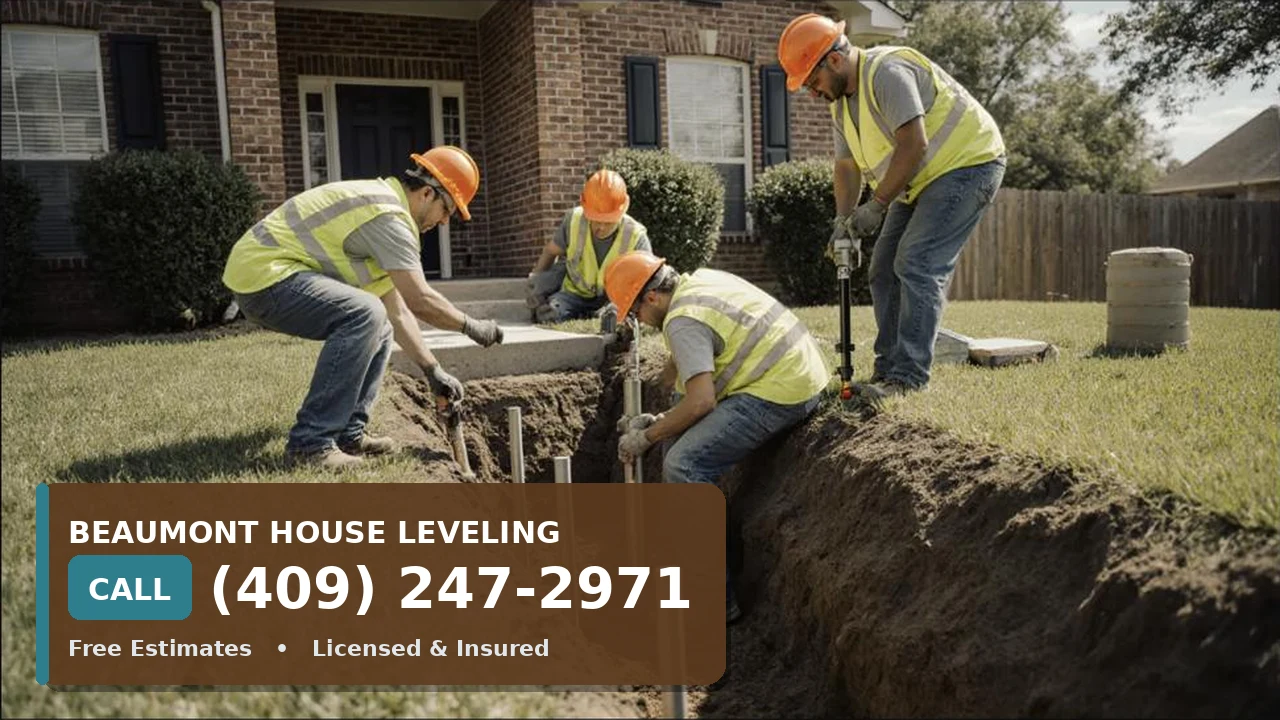
Foundation repair in Beaumont is what a house needs once the clay under it has moved: piers or pilings set below the layer that keeps shifting, then a lift that brings the floor back to level. We work on both kinds of house you find here — the older pier-and-beam homes and the slab homes built since the 1960s — and on every job we measure first, then quote in writing after we have seen the house. Call (409) 247-2971.
How to tell your foundation has moved
Most people notice the house before they think about the foundation. A door that sticks every summer and swings free in winter. A crack in the brick that starts at a window corner and runs up in a stair-step. A floor that slopes toward one wall, a gap opening between the skirting and the floor, a hairline crack across the drywall above a door frame. On a pier-and-beam house you may also feel a bounce in the floor or see daylight under a sill. None of these are proof on their own, but two or three together on the same side of the house usually mean the ground under that side has dropped.
If you are not sure, our guide to the signs of foundation problems goes through each one. The next step is the same either way: we come out and measure.
What foundation repair involves
The repair depends on how the house was built. A pier-and-beam house sits on wood beams over piers, so the fix is under the floor: reset or replace the pads and piers that dropped, shim or sister the beams that sagged, and lift the floor back to level. That work has its own page: pier and beam foundation repair.
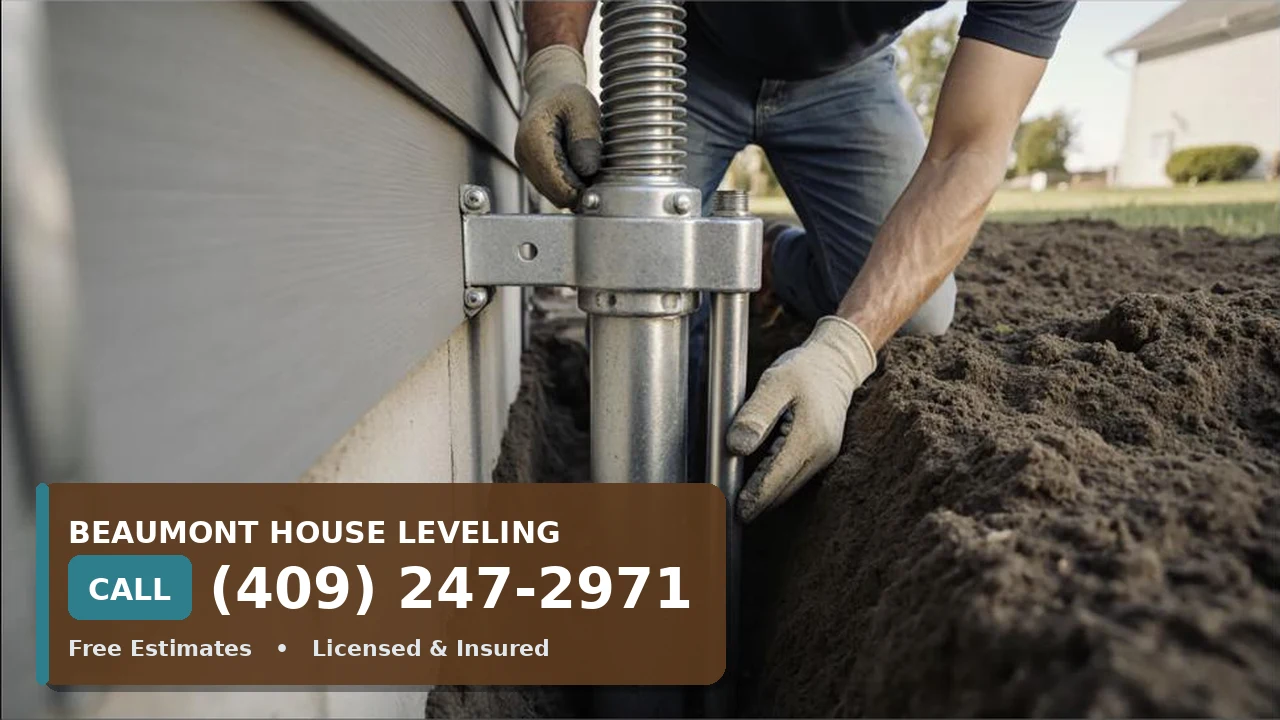
A slab house has no crawlspace, so the fix goes in around the edge of the slab. We dig to the footing, drive concrete pressed pilings or steel piers down below the clay that moves, and use them to lift the slab back into plane. Cracks are sealed after the lift, not before, because a crack filled while the slab is still moving just opens again. That work is on the slab foundation repair page.
On either type, if water is what moved the ground, we fix the water too. Gutters that dump at the wall, ground that slopes toward the house and a crawlspace that stays wet all winter will undo a repair. Drainage correction goes on the same quote when the house needs it.
Call (409) 247-2971 Request a callback
Why houses move around Beaumont
Beaumont, Jefferson County and the towns around it sit on heavy clay that soaks up water and swells in the wet months, then shrinks and pulls away as it dries. A house sitting on that clay goes up and down with it, and it never goes up and down evenly — the shaded side stays wet, the sunny side dries, the side with the leaking gutter swells more. Over a few years that uneven movement is what tilts a slab or drops a pier. A repair that stops in the moving layer moves with it, which is why depth matters more here than in drier parts of Texas. Our guide to foundation repair on Texas clay covers this in plain terms.
What foundation repair costs in Beaumont
Recent foundation repair jobs in the Beaumont area have run $5,000 to $20,000 for a moderate slab or pier-and-beam repair. Concrete pressed pilings have been $300 to $500 each and steel piers $1,000 to $2,000 each, so the count of piers is what moves the price most. Where drainage work is needed on the same job it has added $3,000 to $15,000.
Prices on this page are estimates from previous work. We cannot quote an exact price. The actual cost can be lower or higher depending on the job. The person who knows is the professional who will do the work. You get a written quote after we see the house. The cost page has the full table for every service.
How to get started
Call (409) 247-2971 with the address and what you have noticed, or send the contact form. We come out, measure the floor levels and look at the foundation, and you get a written quote after we see the house. There is no charge for the visit and no obligation.
Related services
Frequently asked questions
How much does foundation repair cost in Beaumont?
Recent jobs have run $5,000 to $20,000 for a moderate repair, with pressed pilings at $300 to $500 each and steel piers at $1,000 to $2,000 each. Prices on this page are estimates from previous work. We cannot quote an exact price. The actual cost can be lower or higher depending on the job. The person who knows is the professional who will do the work. You get a written quote after we see the house.
How do I know if my house needs foundation repair?
Look for doors that stick, cracks in brick or drywall that keep widening, floors that slope or bounce, and gaps around window frames. Two or more of these on the same side of the house is a good reason to have the floor levels measured.
Do you fix pier and beam houses and slab houses?
Yes. Older Beaumont houses on piers and beams get work under the floor; slab houses get pilings or steel piers set around the edge of the slab. Each has its own page on this site.
Will the cracks come back after the repair?
Cracks are sealed after the house is lifted, not before, and the piers or pilings go below the clay that moves. Keeping water away from the foundation afterwards is the other half of it, which is why drainage often goes on the same quote.
Do I need a permit for foundation repair in Beaumont?
Often yes for structural work. Inside the city it is the City of Beaumont building office; outside it is the county. We tell you what applies to your address when we quote, and the paperwork is part of the job.
Do you give prices over the phone?
No. Nobody can see the house from the phone. We come out, measure the floor levels and look at the foundation, and you get a written quote after that. The on-site look is free.
Ready for foundation repair in Beaumont, TX?
Free on-site look at the house, written quote after we see it, no obligation. Call (409) 247-2971.